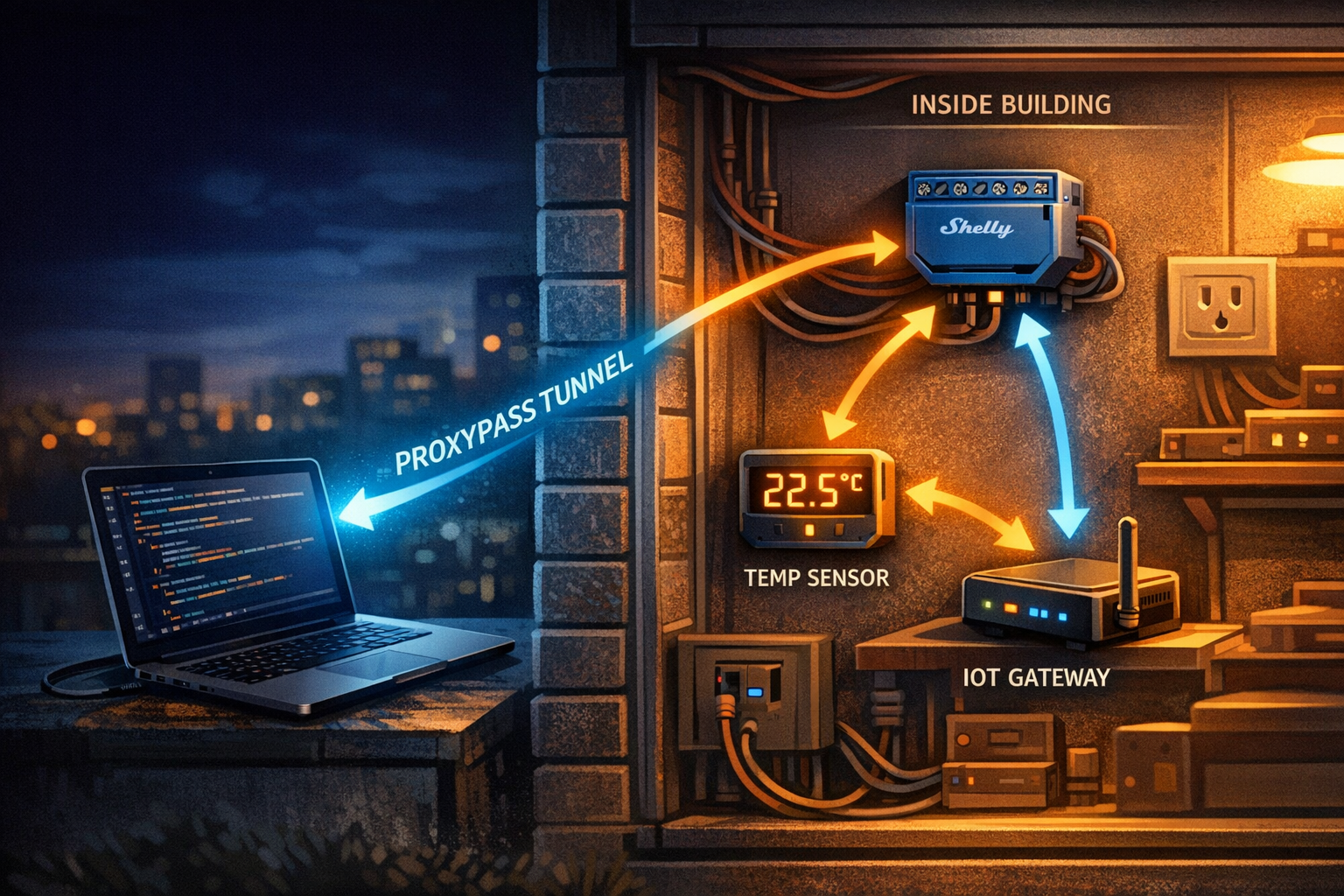
IoT devices are designed to be accessed locally. A Shelly relay exposes its API on http://192.168.1.x. A temperature sensor streams data to a local MQTT broker. A gateway provides a web interface on port 80. All of this works perfectly inside the LAN — and becomes a problem the moment you need to access it from outside.
The Access Problem
Opening ports to the internet is not an option for devices that speak plain HTTP. VPNs add complexity that IoT hardware often cannot support. Cloud-based IoT platforms require vendor lock-in and ongoing subscription fees per device.
The ProxyPass Approach
ProxyPass provides a simpler path. You install a single node on any machine in the same network as your IoT devices — a Raspberry Pi, an existing server, or any Linux or Windows machine. That node tunnels into ProxyPass, and you can reach every HTTP device in the LAN through the REST Bridge.
Scenario: Smart Building Management
A building management company oversees 25 commercial properties. Each building has a mix of IoT devices — Shelly relays controlling HVAC, temperature sensors in server rooms, energy meters on electrical panels, and gateway devices aggregating data.
They deploy one Raspberry Pi with a ProxyPass node at each building. From their central office, they can:
- Toggle a Shelly relay to adjust HVAC in a meeting room that is too warm — a single REST Bridge call to the relay's local API
- Read temperature sensor data from the server room to verify cooling is working — GET request to the sensor's endpoint
- Access the energy meter's web interface to check consumption patterns — browse it through the CONNECT proxy
- Download diagnostic logs from the gateway — mount the log directory via File Mount
All without modifying a single IoT device. The devices continue operating exactly as they did before — serving their local API on their local IP. The ProxyPass node is the only new component in the network, and it makes no inbound connections.
One Node Per Site, Every Device Reachable
For businesses managing IoT deployments across multiple locations — smart buildings, industrial monitoring, agricultural sensors, retail automation — ProxyPass replaces per-site VPN configurations with a single, consistent access layer. One node per site, all devices reachable through one API.