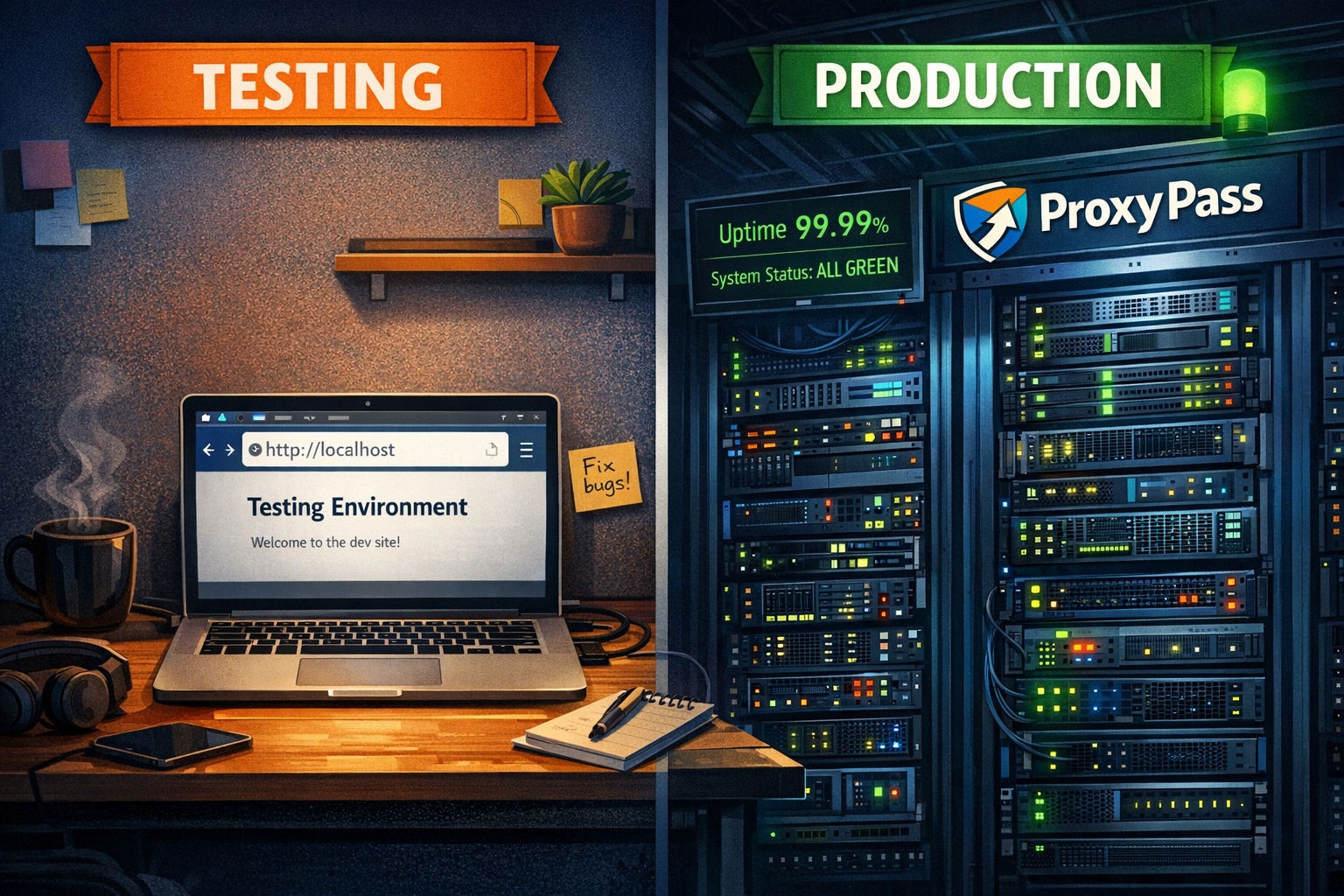
There are many tunneling tools built for development. They help you expose localhost for webhook testing, share a staging server with a colleague, or demo a project to a client. They are fast, developer-friendly, and often free.
ProxyPass is not one of those tools.
Built for Production
ProxyPass is built for production. It is designed for devices that run 24/7, in networks you do not control, with uptime requirements that matter to your business. The difference shows up in every design decision:
Persistence — dev tunnels are ephemeral. Start a CLI, get a URL, close the terminal, the tunnel dies. ProxyPass nodes run as system services (Docker or Windows) that survive reboots, user logouts, and power cycles. They reconnect automatically and stay connected indefinitely.
Identity — dev tunnels use random or session-based identifiers. ProxyPass nodes have hardware-bound IDs tied to the CPU. The identity persists across restarts, updates, and reinstalls. A node is a specific piece of hardware, permanently.
Security — dev tunnels prioritize convenience. ProxyPass provides API key authentication, per-node keys, protected groups with one-time install keys, node blocking with immediate disconnect, and HMAC-SHA256 signed webhooks. These are not features you need for testing — they are features you need when unauthorized access has real consequences.
Fleet management — dev tunnels are individual. ProxyPass manages fleets — groups of nodes with configurable security policies, centralized dashboards, a Management API for automation, remote restart, auto-update, and real-time billing visibility.
Monitoring — dev tunnels give you request inspection. ProxyPass gives you fleet health — which nodes are online, which went dark, error rates, traffic trends, and webhook notifications when something changes.
The Right Tool for the Right Job
If you need to expose a port for five minutes to test a webhook, ProxyPass is overkill. Use ngrok. If you need 200 devices to be reliably accessible for the next three years, with security controls, monitoring, and remote management — that is what ProxyPass is for.
One More Thing
One more thing that separates ProxyPass from dev tools: you know who built it, and you can reach them. Every customer relationship starts with a personal onboarding. Feature requests land with the people who build the product. When something needs attention, you talk to an engineer — not a ticket queue.